|
The Altiplano,
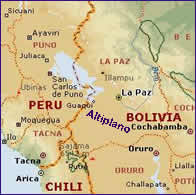
which means « high plains » in Spanish, is the most extensive area of high
plateau on earth outside of Tibet. It is an area of inland drainage lying
in the central Andes (South America), occupying parts of Chile, Argentina,
Bolivia and Peru. The major area of the Altiplano
is located in Bolivia. Its height averages about 3,300 meters (11,000
feet). It is dominated by the massive peaks of active volcanoes to the
west. The Atacama Desert, the driest area on the whole planet, lies to the
southwest of the Altiplano. In contrast at east lies the humid Amazon rainforest.
|
|
|
|
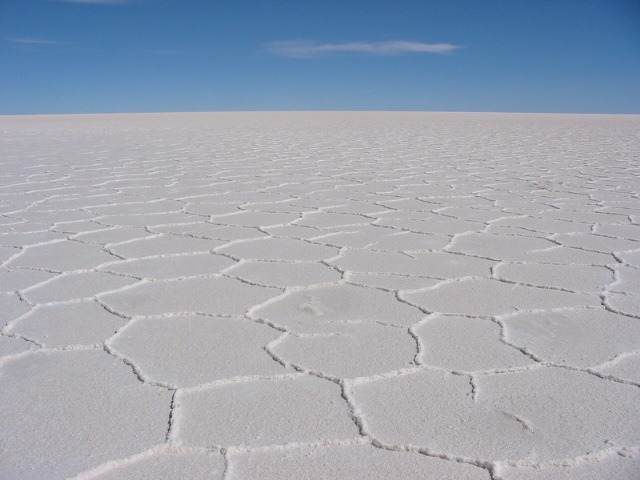
Salar de Uyuni
|
|
The llama (Lama glama) is a camelid, a family that evolved
originally in North America 40-50 million years ago. The term llama is
sometimes used more broadly, to indicate any of the four closely related
animals that make up the South American branch of the family Camelidae: the
true llama, the vicuña, alpaca and guanaco. They were used as a system of
transportation for the Incas.
Before the Spanish invasion on the South-American continent, the llama was
the only domestic animal. Used as beast of burden, it was very prized for
its fur and its meat. He carried out the job of a horse, a ox and a sheep.
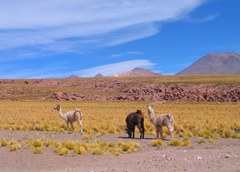
Today, the llama mainly lives in the Altiplano, on the high plains the
Andes cordillera.
|
|
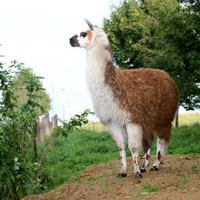
The llama is herbivore, which means he only eats grass and leaves (2
to 3 kg every day). The female generally lives in small group with a male.
He is viviparous like most of the mammals. He can live without water and
food longer than most of the others. The llama loves to spit, but it’s only
to defend himself. Their life expectancy is between 15 and 20 years.
|
Kapaï
|
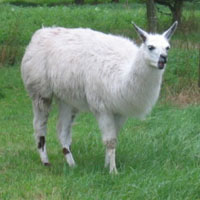
Salsa
|
|
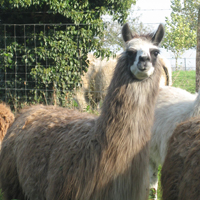
Samba
|
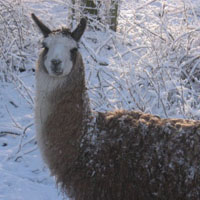
Topkapi
|
|
Your hosts at the Altiplano des
Collines
|
|
